You picked the orange cat at the shelter because everyone said gingers are the friendliest. But then your new cat bit you on day three. Sound familiar? The idea that the color of cats and personality are linked is everywhere — but the science is messier, and more interesting, than most articles admit. Here’s an honest breakdown, color by color, with the genetics and the caveats included.
Does Cat Coat Color Actually Affect Behavior?
The short answer: possibly, but not the way you think.
Two studies from the University of California get cited constantly in this conversation — and they directly contradict each other.
In a 2012 UC Berkeley study published in Anthrozoos, 189 cat owners rated orange cats as the friendliest. White cats were labeled aloof. Tortoiseshell cats? Too much attitude.
Then a UC Davis study surveyed 1,274 owners and measured aggression across three settings: at home, during handling, and at the vet. The result flipped the script — female orange cats ranked among the most aggressive. Gray-and-white cats showed the highest aggression at vet visits. Black, white, gray, and tabby cats scored lowest overall.
Same question. Very different answers.
Why the Research Is Hard to Trust
Both studies share the same fundamental flaw: they rely entirely on owner self-report. No behavioral observation. No controlled environment. What one owner calls “feisty,” another calls “playful.”
peer-reviewed animal behavior research methodology
As animal behaviorists have noted, self-reported surveys measure owner perception, not objective cat behavior. That distinction matters enormously when you’re trying to draw conclusions about millions of cats.
The Gene Connection: Pleiotropy
Here’s what almost no cat article bothers to explain: the biological reason color might influence behavior is called pleiotropy — when a single gene affects multiple, seemingly unrelated traits simultaneously.
Some coat color genes are located near genes that influence neurological development and neurotransmitter regulation. This is an active area of research, not a settled fact. But it’s the most credible biological mechanism on the table — and it’s why the conversation isn’t entirely without merit.
Cat Coat Color Personality Traits: A Color-by-Color Breakdown
Take this section as informed pattern-recognition, not prediction. Individual variation always wins.
| Coat Color | Commonly Reported Traits | Aggression Level* | Key Note |
|---|---|---|---|
| Orange / Ginger | Affectionate, bold, social | Moderate–High (females) | Sex matters significantly |
| Black | Calm, loyal, independent | Low | Often unfairly stigmatized |
| Tortoiseshell | Strong-willed, expressive | High | Almost always female |
| Calico | Independent, headstrong | High | Also predominantly female |
| Tabby | Friendly, curious, adaptable | Low | A pattern, not a color |
| White | Gentle, calm | Low–Moderate | May have hearing loss |
| Gray / Blue | Reserved, intelligent | Low | Breed affects this a lot |
| Tuxedo (B&W) | Playful, loyal, mischievous | Low–Moderate | Popular for a reason |
Based on UC Davis 2015 survey data; self-reported by owners
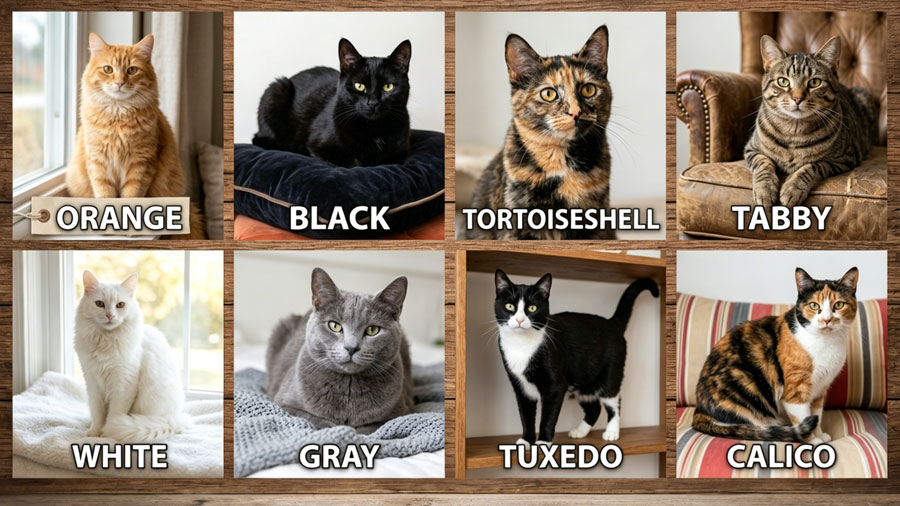
Orange / Ginger Cats
Orange cats have a reputation that precedes them — bold, social, a little dramatic. Many owners describe them as “dog-like” in their affection and their tendency to follow you around.
But the UC Davis data adds a layer: female orange cats showed notably higher aggression scores, particularly at home and during handling. Male orange cats tracked closer to the friendlier reputation. If you’re choosing an orange cat, the sex of the animal may matter more than the color.
Black Cats
Black cats carry centuries of unfair cultural baggage. In the U.S., they’re adopted at lower rates than almost any other color — a phenomenon shelters call Black Cat Syndrome. That’s a problem, because owners consistently rate them as calm, loyal, and affectionate.
why black cats stay in shelters longer and how to help
Their reputation for being “aloof” or “mysterious” appears to be more about human projection than actual behavior. If you want a low-drama, deeply bonded cat, a black cat is worth serious consideration.
Tortoiseshell & Calico Cats — The “Tortitude” Factor
“Tortitude” is real — at least according to owner reports. Both tortoiseshell and calico cats scored high on aggression in the UC Davis study, particularly in response to handling.
Here’s something most articles skip entirely: nearly all tortoiseshell and calico cats are female. That’s because the genes that produce those coat patterns are carried on the X chromosome. Males would need two X chromosomes (XXY) to express the pattern — which is genetically rare and usually results in sterility.
This matters because hormonal differences between sexes influence behavior. You’re not just comparing coat colors when you compare a tortoiseshell to a black cat — you’re also comparing a female to a cat that could be either sex.
Tabby Cats
Quick clarification that most articles get wrong: tabby is a coat pattern, not a color. Tabbies can be orange, gray, brown, or silver. The defining feature is the “M” marking on the forehead and the striped or swirled pattern on the body.
Owner reports consistently describe tabbies as friendly, adaptable, and sociable. They tend to do well in multi-pet households and are often recommended for first-time cat owners.
White Cats
White cats are frequently described as calm and gentle — but there’s a medical factor that significantly changes this picture.
According to Cornell University College of Veterinary Medicine, 65–85% of white cats with two blue eyes are deaf. The number drops to 40% for white cats with one blue eye, and 17–22% for those without blue eyes.
feline deafness and white coat genetics
A cat that doesn’t respond when you call them isn’t being aloof. They may simply not hear you. If you have a white cat, a BAER (Brainstem Auditory Evoked Response) test at your vet can confirm hearing status.
Gray Cats
Gray cats are often described as quiet, independent, and observant — the cats that watch from the windowsill rather than run to greet you at the door. That said, many owners report deep bonds with their gray cats once trust is established.
Note: specific breeds like the Russian Blue carry their own well-documented personality traits that go beyond coat color. If you’re looking at a gray purebred, research the breed separately.
What Actually Shapes a Cat’s Personality
Coat color is a weak signal at best. These factors matter far more:
Early Socialization (3–9 Weeks)
The American Association of Feline Practitioners (AAFP) identifies the window between 3 and 9 weeks as the critical socialization period. Kittens handled regularly during this time are significantly more likely to be comfortable around humans as adults.
Miss that window, and no coat color in the world changes the outcome.
Genetics and Parental Temperament
Personality is heritable. A laid-back father and mother tend to produce laid-back kittens — regardless of color. If you’re buying from a breeder, ask to meet the parents. If you’re adopting from a shelter, ask the staff about the cat’s observed behavior, not its appearance.
Sex and Neuter Status
The UC Davis study found that sex was a stronger predictor of aggression than coat color in several categories. Unspayed females tend to show more territorial behavior. Neutering and spaying reduce hormonally driven aggression in most cats — something no discussion of cat personality should leave out.
Your Own Behavior as an Owner
Cats read their environment. A cat raised in a loud, unpredictable home will behave differently than a genetically identical cat raised in a calm one. Owner consistency, patience, and handling style all shape who a cat becomes.
Choosing a Cat by Color? Read This First
| Your Situation | Consider | Why |
|---|---|---|
| Family with young kids | Orange tabby (male), tuxedo | Social, tolerant, playful |
| Quiet home, first-time owner | Black cat, gray cat | Calm, lower-maintenance bonding |
| Experienced cat owner | Tortoiseshell, calico | Rewarding but requires patience |
| Multi-pet household | Tabby | Adaptable, sociable |
Use color as a starting point — not a decision. Spend time with the specific cat. Watch how they respond to your hand, your voice, your pace. That ten minutes of observation will tell you more than any coat color theory.
And one more thing worth saying plainly: no cat should be returned to a shelter because their personality didn’t match what their coat color was supposed to predict. Cats adapt. So do owners.
FAQ
Q: What is the friendliest cat color?
Orange and tabby cats are most frequently reported as friendly by owners. But individual personality, socialization history, and sex are stronger predictors than color alone.
Q: Are tortoiseshell cats really more aggressive?
The UC Davis study found tortoiseshell and calico cats scored higher on aggression, particularly during handling. This may be partly explained by the fact that nearly all tortoiseshell cats are female, and hormonal factors play a role.
Q: Is there real science linking cat color to personality?
There’s survey-based evidence suggesting a correlation, but no controlled behavioral studies confirm a causal link. The most credible biological mechanism is pleiotropy — genes that affect both coat color and neurological traits — but this is still an active research area.
Q: Why do white cats seem aloof?
Some white cats, especially those with blue eyes, are deaf or partially deaf. A cat that doesn’t respond to its name isn’t ignoring you — it may not hear you. Ask your vet about a BAER hearing test.
Q: Does a male or female cat’s color matter differently?
Yes. The UC Davis study found that sex interacts with coat color in aggression data. Female orange, gray-and-white, and calico cats showed higher aggression scores than their male counterparts. Sex is often a more reliable behavioral predictor than color.
Disclaimer: The information in this article is for general educational purposes only and should not be taken as professional veterinary or behavioral advice. Every cat is an individual. For behavioral concerns or health questions, consult a licensed veterinarian or certified applied animal behaviorist.

