Most kittens open their eyes between 7 and 14 days old — but that’s just the beginning. If you’re raising a newborn litter (with or without a mother cat), knowing what’s normal versus what needs a vet call can make all the difference. This guide walks you through every developmental stage, what healthy eyes look like, how to clean them safely, and the warning signs you should never ignore.
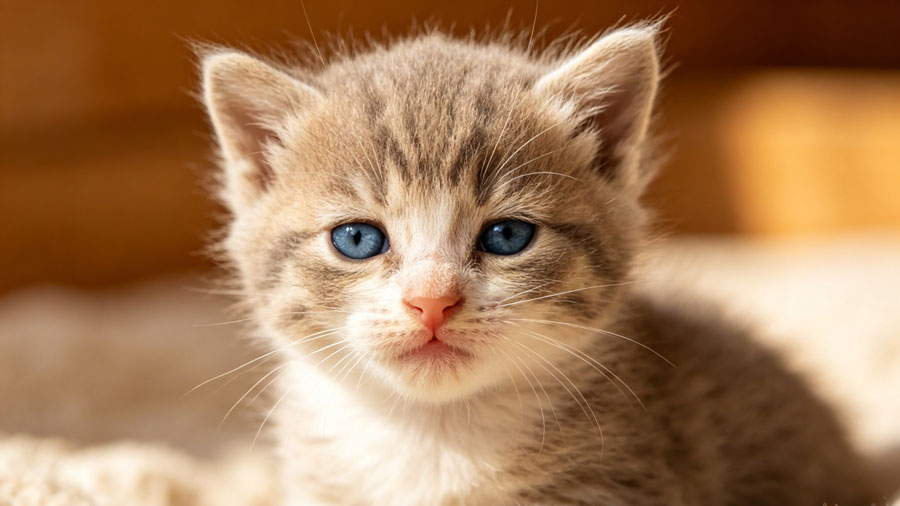
Why Are Kittens Born with Their Eyes Closed?
It’s not an accident — it’s biology.
Kittens are what scientists call altricial animals, meaning they’re born in an early developmental stage and need significant parental care to survive. At birth, a kitten’s optic nerves and retinal cells are still forming. Opening the eyes too early would expose fragile, undeveloped tissue to light, bacteria, and physical damage.
There’s another reason: a newborn kitten’s tear glands haven’t switched on yet. Without the tear film to keep the eye surface moist and protected, open eyes would dry out and become infected within hours.
Closed eyelids act as a sealed barrier — keeping the eye surface hydrated and shielded while everything develops underneath.
Dogs and rabbits are born the same way. It’s a common strategy among mammals whose young are born neurologically immature.
When Do Kittens Open Their Eyes? The Full Timeline
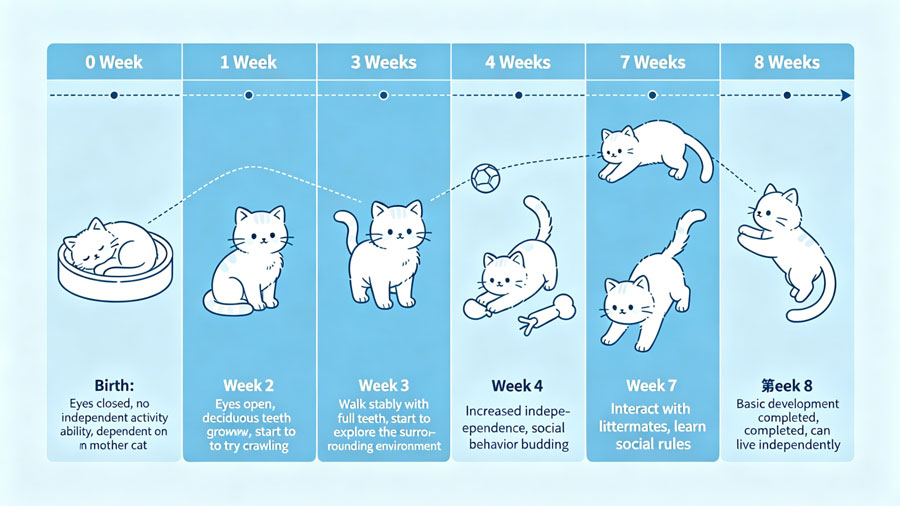
Days 0–7: Sealed Shut, Running on Instinct
Newborn kittens arrive with their eyes fully closed and ears folded flat against their heads. They can’t hear, they can’t see, and they can’t regulate their own body temperature.
What they can do: smell and feel heat. Those two senses are enough to navigate toward their mother’s belly for warmth and milk.
One thing many owners don’t realize: bright light can still harm a kitten whose eyes are closed. The eyelids at this stage are thin enough that intense light penetrates the tissue. Keep newborns in dim, warm environments — no overhead fluorescents, no camera flashes.
At this stage, the umbilical cord is still present and most movement is a slow crawl toward mom. Kittens urinate and defecate only when the mother licks their abdomen to stimulate the reflex.
Days 7–14: The First Signs of Opening
This is when things get exciting.
Somewhere between day 7 and day 14, you’ll notice a thin line of light appear along the eyelid seam. The eyes are starting to crack open. By day 14, most kittens have both eyes at least partially open.
A few things to know during this stage:
- It’s normal for one eye to open before the other. Don’t panic if the left eye is open and the right is still sealed on day 10. Give it a few more days.
- Vision is extremely limited. At this point, kittens detect light and movement — nothing more. Think frosted glass.
- Never force the eyes open. If an eye seems stuck, do not pry it apart with your fingers. More on safe cleaning below.
Weeks 2–3: Both Eyes Open, Vision Still Developing
By week 2, both eyes are typically fully open. Every kitten starts with blue eyes — this isn’t the final color. The blue appearance comes from a lack of active melanin-producing cells (melanocytes) in the iris. Pigment production hasn’t kicked in yet.
At this stage, kittens are light-sensitive. Bright overhead lights cause discomfort. Their pupils can’t yet dilate and constrict efficiently, so they rely on low, warm lighting.
Vision at 2–3 weeks: blurry, flat, and close-range. Kittens begin responding to movement but have no depth perception yet.
Weeks 4–6: Depth Perception Kicks In
Watch a 4-week-old kitten closely — you’ll see the moment it starts stalking things. That’s depth perception coming online.
The pupils now dilate and constrict in response to light. Kittens start tracking moving objects, pouncing (with poor accuracy), and interacting with littermates more deliberately.
By week 6, vision and hearing are functional enough for socialization. This is a key window for human handling — kittens exposed to people during weeks 3–7 become significantly more comfortable with humans as adults.
how to socialize kittens during the critical development window
Week 8 and Beyond: True Eye Color Appears
By 8 weeks, the melanin in the iris has settled enough to reveal the cat’s permanent eye color. The change from blue to the adult color can happen gradually over weeks 6–12.
Common adult eye colors by breed:
| Breed | Typical Adult Eye Color |
|---|---|
| Siamese | Blue (permanent) |
| Tabby | Amber, green, or gold |
| Russian Blue | Vivid green |
| Persian | Copper or blue |
| Maine Coon | Gold, green, or copper |
| Ragdoll | Blue (permanent) |
| Domestic Shorthair | Wide range — green, gold, hazel |
White cats with blue eyes have a higher likelihood of being deaf — this is linked to the same gene that suppresses pigment in both the iris and the cochlea.
Eye Care: What to Do Based on Your Situation
If the Mother Cat Is Present
In most cases: let her do her job.
A healthy mother cat will lick her kittens’ faces regularly, which keeps eyes clean and stimulates healthy development. Your role is to:
- Keep the nesting area clean and dry
- Check kittens daily for signs of discharge or swelling
- Step in only if the mother is neglecting a specific kitten
If you notice the mother consistently ignoring one kitten — not nursing it, not grooming it — that kitten may need your direct care and a vet assessment.
If You’re Raising an Orphan Kitten
Without a mother, eye hygiene becomes your responsibility.
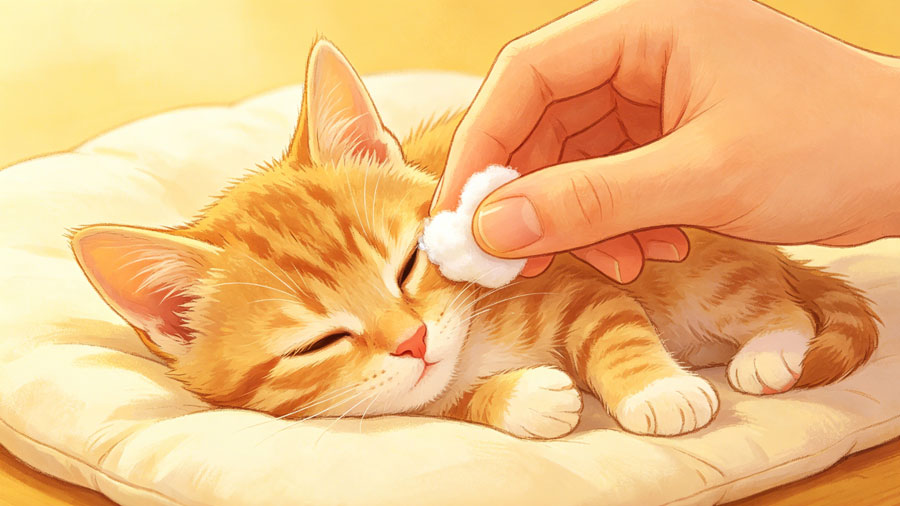
Safe eye cleaning technique:
- Use a clean cotton ball or soft gauze — never a rough cloth
- Dampen with warm, sterile saline solution or plain cooled boiled water
- Wipe gently from the inner corner outward — one swipe per cotton ball
- Never scrub or apply pressure
- Clean once or twice daily, or whenever you notice crusting
Never use:
- Human eye drops (even “gentle” or “natural” ones)
- Baby wipes or any wipes with fragrance or alcohol
- Hydrogen peroxide
- Soap of any kind
- Cotton swabs directly on the eye
For persistent debris, a kitten-safe sterile eye wash (such as those designed specifically for cats) is appropriate — ask your vet which product they recommend before purchasing.
Normal vs. Abnormal: A Quick-Reference Guide
| What You See | What It Means |
|---|---|
| Small amount of clear discharge | ✅ Normal |
| One eye opens slightly before the other | ✅ Normal |
| Eyes fully closed at day 10 | ⚠️ Monitor — clean gently, recheck in 48h |
| Mild crusting along the lash line | ⚠️ Clean with saline, watch for worsening |
| Yellow or green discharge | 🚨 Vet visit — possible infection |
| Eyelids fused shut with discharge underneath | 🚨 Same-day vet visit |
| Swollen, bulging eyelid before eye opens | 🚨 Emergency — fluid may be trapped |
| One eye visibly smaller than the other | 🚨 Possible microphthalmia — vet assessment needed |
Common Kitten Eye Conditions to Know
Neonatal conjunctivitis is the most common eye problem in kittens under 3 weeks. It’s typically caused by bacterial infections (often Chlamydophila or Bordetella) or feline herpesvirus. Signs: swollen lids, discharge, eyelids stuck together. Treatment requires a vet — do not attempt to treat with over-the-counter products.
Entropion is when the eyelid rolls inward, causing lashes to scratch the eye surface. It’s painful and leads to chronic tearing and discharge. More common in Persian and Himalayan cats. Mild cases sometimes resolve as the kitten grows; severe cases require surgery.
Microphthalmia — an abnormally small eye present at birth — is a congenital condition with no cure. Affected kittens require ongoing monitoring to prevent secondary complications.
Herpetic eye disease caused by feline herpesvirus-1 (FHV-1) can cause recurring flare-ups throughout a cat’s life, often triggered by stress. Kittens with FHV-1 need antiviral support and regular vet monitoring.
Flat-Faced Breeds Need Extra Attention
If you have a Persian, Exotic Shorthair, Ragdoll, or British Shorthair, their facial anatomy puts them at higher risk for eye problems — even when everything is developing normally.
Brachycephalic cats have shallow eye sockets and shortened tear ducts. Tears don’t drain properly, leading to chronic overflow onto the face (epiphora), staining, and skin irritation beneath the eyes.
These breeds need daily face cleaning with a damp cloth — not just during kittenhood, but for life.
Nutrition and Eye Development
The eyes don’t develop in isolation — they need the right fuel.
DHA (docosahexaenoic acid), an omega-3 fatty acid, is essential for retinal development in kittens. Mother’s milk contains DHA naturally. If you’re bottle-feeding an orphan kitten, use a kitten milk replacer (KMR) that lists DHA in its ingredients.
Never substitute with:
- Cow’s milk (causes diarrhea and provides no useful nutrition for kittens)
- Goat’s milk (better than cow’s milk, but still not a complete replacement)
- Human infant formula
Once kittens transition to solid food (around week 4–5), choose a diet labeled “complete and balanced for growth” per AAFCO standards, from a reputable brand. Quality kitten-specific diets contain the DHA levels needed to support continued eye and brain development through the first year.
When to Call Your Vet
Schedule a routine visit when kittens are 4–6 weeks old — even if everything looks fine. This first exam establishes a health baseline, confirms normal eye development, and gets vaccinations on schedule (first round at 6–8 weeks).
Call the vet promptly if you notice:
- Any discharge that is yellow, green, or thick
- Eyelids that remain sealed past day 14–16
- Swelling around the eye before it opens
- A kitten that’s not nursing, is losing weight, or seems lethargic alongside eye symptoms
Go to an emergency vet immediately if you see a bulging or sunken eye, visible trauma, or an eyelid that appears to be fused with discharge pooling underneath.
FAQ
Q: What if my kitten’s eyes haven’t opened by 2 weeks?
Give it until day 16 before worrying. Some kittens — especially those from larger litters or smaller breeds — open their eyes slightly later. If there’s no sign of any opening by day 16, call your vet.
Q: Is it normal for one eye to open before the other?
Yes. One eye can open several days before the other. As long as both are open by week 3 and neither shows signs of discharge or swelling, this is completely normal.
Q: Why does my kitten’s eye look cloudy or bluish after opening?
All kittens have blue eyes at first due to low melanin production. A slight bluish haze is normal in the first few weeks. True cloudiness — a white or gray film over the pupil — warrants a vet check, as it can indicate a corneal issue or cataract.
Q: Can I use human eye drops on my kitten?
No. Even preservative-free human saline drops can be inappropriate for kittens. Only use products specifically recommended by your vet for feline use.
Q: At what age can kittens see clearly?
Full visual acuity — comparable to adult cat vision — develops around 10–12 weeks. Even then, cats are naturally more nearsighted than humans, but they excel in low-light and motion detection.
Q: Do all kittens start with blue eyes?
Yes. All kittens are born with blue or blue-gray eyes. Permanent color develops between 6–12 weeks as melanin production increases.
Q: What does a kitten eye infection look like?
Look for yellow or green discharge, swollen or sealed eyelids, redness around the eye, or a kitten that’s squinting or pawing at its face. Any of these signs warrant a vet visit — infections at this age can progress quickly.
Wrapping Up
Watching a kitten open its eyes for the first time is one of those small, unforgettable moments. One day the lids are sealed; the next, two cloudy blue eyes are taking in the world for the first time.
What you do in those first weeks — keeping the environment clean, watching for warning signs, and getting them to a vet on schedule — sets the foundation for a lifetime of healthy vision.
If anything seems off, trust your instincts and call your vet. Early intervention makes all the difference.
Disclaimer: This article is intended for general informational purposes only and does not constitute veterinary medical advice. Every kitten is different, and individual health concerns should always be evaluated by a licensed veterinarian. If you have concerns about your kitten’s eye development or overall health, please contact your vet promptly.

