You walk into the kitchen and find your cat face-deep in the dog’s bowl. Can cats eat dog food without getting hurt? One stolen bite won’t land your cat in the emergency clinic — but the answer gets complicated fast. This guide breaks down exactly what happens to your cat’s body when dog food becomes a habit, which ingredients are genuinely toxic, and what to do if your cat has already been eating it for days.
Reviewed for medical accuracy by a licensed veterinarian. See disclaimer at the end of this article.
The Short Answer: Safe Once, Risky Often, Dangerous Long-Term
Here’s the honest risk breakdown:
| Scenario | Risk Level | What to Do |
|---|---|---|
| A few stolen bites, once | Negligible | Monitor for 24 hours |
| 1–3 days (emergency situation) | Low | Switch back to cat food ASAP |
| 1–2 weeks as main diet | Moderate | See a vet; check taurine levels |
| Months as primary food | High / Potentially fatal | Urgent vet visit required |
This time-based framework is what most articles skip entirely. Dog food is not poisonous to cats in the way that onions or xylitol are — but it is nutritionally incompatible at a fundamental level. The longer it goes on, the more damage accumulates.
Why Cat Food and Dog Food Are Built Differently
Cats are obligate carnivores. Their bodies evolved to run almost entirely on animal protein and fat. Dogs are omnivores — they can extract energy and nutrients from grains, vegetables, and meat. That single biological difference drives every formulation decision in pet food manufacturing.
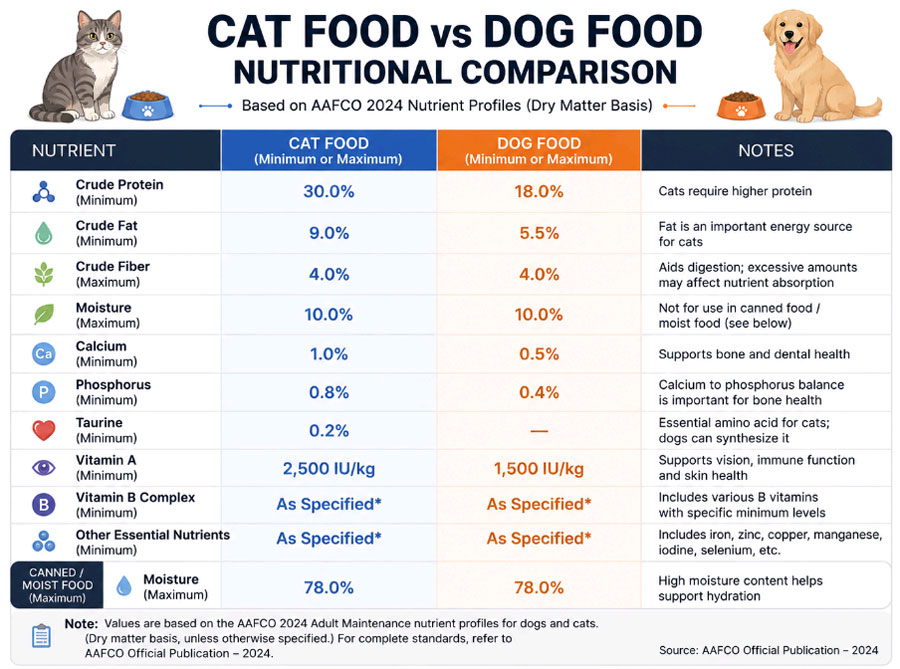
Here’s how the numbers actually compare:
| Nutrient | Cat Food (AAFCO Min.) | Dog Food (AAFCO Min.) | Risk if Cat Eats Dog Food |
|---|---|---|---|
| Protein (dry matter) | ≥30% adult, ≥35% kitten | ≥18% | Muscle loss, immune decline |
| Taurine | Required (mandatory) | Not required | Heart disease, blindness |
| Vitamin A | High supplementation | Low supplementation | Night blindness, coat deterioration |
| Arachidonic acid | Must be added | Dogs synthesize it | Abnormal liver/kidney values |
| Niacin | Must come from animal tissue | Plant sources acceptable | Digestive dysfunction |
AAFCO cat food nutrient profiles
Protein: Cats Need Almost Twice What Dogs Do
A standard adult dog food contains roughly 18–26% protein on a dry matter basis. Cats need a minimum of 30%, with many vets recommending 30–34% for adults and 35–45% for growing kittens.
This isn’t a minor gap. A cat’s liver enzymes are permanently set to process high protein loads. Unlike dogs, cats can’t simply “turn down” their protein metabolism when dietary protein drops. They start breaking down their own muscle tissue to compensate — and that process starts within days, not months.
Taurine: The Amino Acid That Protects Your Cat’s Heart and Eyes
Taurine is where dog food’s shortcomings become genuinely dangerous. Cats (unlike dogs) cannot synthesize taurine on their own. Every milligram must come from food.
Dog food is not required to contain taurine. Cat food is.
Taurine deficiency in cats leads to two well-documented conditions:
- Dilated cardiomyopathy (DCM): The heart muscle weakens and enlarges. In advanced cases, it causes heart failure. When caught early, treatment with 500mg oral taurine daily can reverse it — but the window is narrow.
- Central retinal degeneration (CRD): The structural cells of the retina deteriorate. If veterinary intervention doesn’t happen in time, the damage to vision is permanent.
feline taurine deficiency and dilated cardiomyopathy
Watch for these early warning signs of taurine deficiency:
- Reduced activity or reluctance to jump
- Slow pupil response in low light
- Labored breathing after minimal exertion
- Loss of appetite for more than 48 hours
Vitamin A, Arachidonic Acid & Niacin
These three deficiencies are slower to show up — sometimes taking months — which makes them easy to miss.
Cats cannot convert beta-carotene into vitamin A (dogs can). A cat eating only dog food will gradually develop coat deterioration, muscle weakness, and in severe cases, night blindness. Arachidonic acid deficiency shows up as abnormal liver and kidney values, often caught incidentally on bloodwork. Niacin deficiency, when plant-heavy dog food replaces animal-tissue-rich cat food, can impair digestion and growth.
What Dog Food Does to Your Cat’s Gut
Dog food’s higher carbohydrate content creates a chain reaction in a cat’s digestive system — one that starts subtle and turns serious.
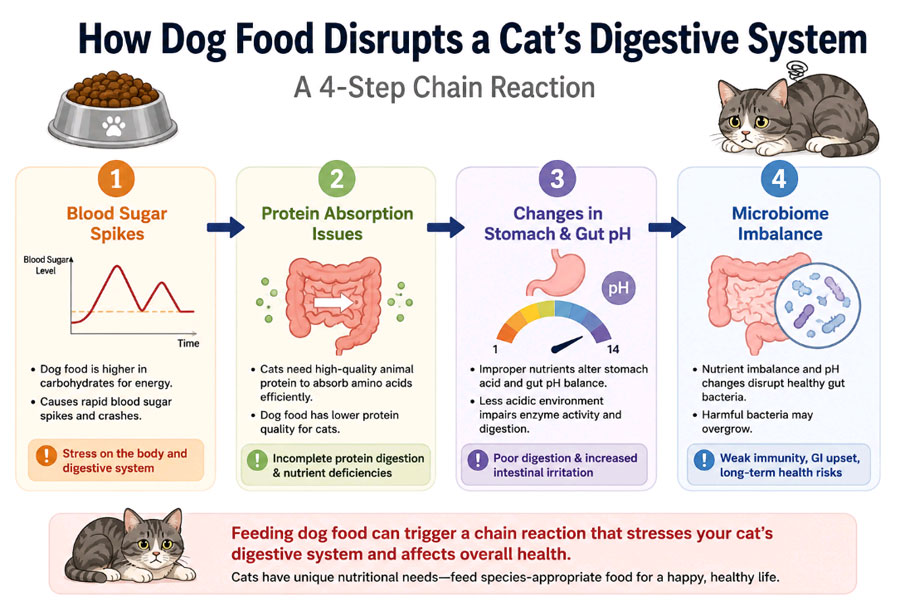
- Blood sugar spikes. Cats lack the metabolic enzymes to handle high-carb loads efficiently. Excess starch gets stored as fat — a direct path toward obesity and, eventually, diabetes.
- Protein absorption drops. Carbohydrates move through the digestive tract faster than protein. When dog food rushes through, the cat extracts less usable protein from each meal.
- Colon pH shifts. Undigested carbs ferment in the large intestine, producing organic acids that make the colon environment more acidic than it should be.
- Gut bacteria shift. The acidic environment suppresses beneficial bacteria. The result: gas, loose stool, vomiting, and abdominal cramping.
Long-term consequences of a dog-food-heavy diet include fatty liver disease, inflammatory bowel disease, diabetes, and chronic food intolerances. Aim to keep carbohydrate content below 10% on a dry matter basis in your cat’s food.
Hidden Toxins: Ingredients in Dog Food That Can Poison Cats
The nutritional mismatch is the main problem. But certain dog food and dog treat ingredients are directly toxic to cats — not just nutritionally inadequate.
Ingredients to Check Every Label For
- Onion, garlic, leeks: Cause oxidative damage to red blood cells. Regular exposure leads to Heinz body anemia — a blood disorder characterized by weakness, pale gums, and rapid breathing.
- Propylene glycol: A moisture-retaining additive found in some semi-moist dog treats. In cats, it triggers Heinz body anemia at much lower doses than in dogs.
- Xylitol: A sugar substitute appearing in some “natural” or grain-free dog products. Acutely toxic to cats and dogs alike; can cause liver failure.
Emergency contact: If your cat ingests any of the above, call the ASPCA Animal Poison Control Center: (888) 426-4435 immediately. Have the product label ready.
Can Cats Eat Dog Treats? A Specific Warning
The occasional plain dog biscuit probably won’t hurt your cat. But “plain” is doing a lot of work in that sentence.
Before letting your cat near any dog treat, flip the bag and scan for onion powder, garlic extract, or propylene glycol. These appear more often than you’d expect — even in premium brands. If you see them, keep that treat completely out of your cat’s reach.
My Cat Already Ate Dog Food — What Do I Do Now?
This is the question almost no article answers directly.
It Was Just Once (Or a Few Bites)
No emergency. Monitor your cat for 24 hours. Specifically watch for vomiting, diarrhea, or unusual lethargy. If none of those appear, your cat is almost certainly fine.
Your Cat Has Been Eating Dog Food for Days or Weeks
Don’t abruptly switch back to cat food — that alone can cause digestive upset. Instead, transition over 3–5 days:
- Days 1–2: 75% dog food, 25% cat food
- Days 3–4: 50/50 mix
- Day 5 onward: 100% cat food
If the dog-food period lasted more than two weeks, schedule a vet visit. Ask specifically about a taurine blood level test and, if your vet sees any cardiac concerns, a cardiac ultrasound. These aren’t expensive tests, and they catch DCM while it’s still reversible.
Go to the Vet Immediately If You See These Signs
- Breathing that looks labored or rapid at rest
- Collapse or sudden extreme weakness
- Persistent vomiting (more than three times in 12 hours)
- Cloudy eyes or visible changes in pupil response
- Pale or white gums
signs your cat needs emergency veterinary care
Kittens, Adults, and Senior Cats Don’t Have the Same Risk
Age changes the stakes significantly.
| Life Stage | Primary Risk from Dog Food | Urgency |
|---|---|---|
| Kitten (under 1 year) | Stunted growth, neurological development gaps, taurine deficiency hits faster | Highest — never use dog food |
| Adult cat (1–7 years) | Gradual muscle loss, nutritional deficiency over weeks to months | High |
| Senior cat (7+ years) | Accelerated muscle wasting, harder to recover from protein deficits | High — seniors have less reserve |
Kittens are in the highest-risk category. Their protein and DHA requirements during the first year are precise — dog food can’t come close to meeting them.
How to Stop the Food Crossover in a Multi-Pet Home
Preventing cats and dogs from eating each other’s food takes a bit of setup, but it becomes automatic once the habits are in place.
Feeding Station Strategies
- Elevated feeding: Place the cat’s bowl on a counter, shelf, or cat tree. Most dogs can’t follow. Most cats prefer it anyway.
- Microchip-activated feeders: These open only for the registered pet. Worth the investment if you have a persistent food thief in either direction.
- Separate rooms at mealtime: The simplest fix. Feed them in different spaces, set a 20-minute window, then pick up both bowls.
Scheduled Feeding vs. Free Feeding
Free feeding works for some cats — but in a multi-pet household, it’s an open invitation for crossover. A structured twice-daily schedule is easier to supervise and has added benefits: it makes medication administration straightforward, helps you notice appetite changes early, and reduces inter-pet tension around food.
Teach Your Dog “Leave It”
A solid “leave it” command eliminates most opportunistic bowl-raiding from the dog’s side. Five minutes of practice per day for two weeks is typically enough to make it reliable around food.
FAQ: What Cat Owners Actually Search For
Can cats eat wet dog food?
Same rules apply as dry — the format doesn’t change the nutritional mismatch. Wet dog food is lower in the protein, taurine, and vitamins cats need. A bite is fine; a habit is not.
Can a kitten eat dog food?
No. Kittens have the most precise nutritional requirements of any feline life stage. Dog food lacks the protein density, DHA, and taurine levels essential for brain and cardiac development.
Will dog food kill a cat?
Not immediately, and not from one meal. But long-term feeding has been directly linked to fatal dilated cardiomyopathy and irreversible vision loss in clinical case reports. The risk is real — it just builds slowly.
How long can a cat survive on dog food?
There’s no clean answer, because it depends on the cat’s age, the specific dog food, and whether any cat food is mixed in. As a practical guideline: 1–3 days in a genuine emergency is low-risk. Beyond one week, nutritional deficits start accumulating. Beyond several weeks, organ-level damage becomes possible.
Can cats eat grain-free dog food?
Grain-free does not mean cat-appropriate. The taurine deficiency problem exists regardless of carbohydrate source. Grain-free dog food is still formulated for canine biology.
My cat only wants to eat dog food — what’s going on?
This is usually a palatability issue with the current cat food, not a genuine preference for dog food. Try switching to a higher-protein wet cat food with a stronger aroma. Cats are driven by smell more than taste, so texture and scent often matter more than flavor.
The Bottom Line
Dog food won’t poison your cat in a single meal. But it was engineered for a completely different animal — one with a different digestive system, different amino acid requirements, and different metabolic machinery. Feeding it long-term isn’t just suboptimal. It creates real, measurable, sometimes irreversible health damage.
Keep the bowls separate. If crossover happens, use the recovery steps above. And if your cat has been eating dog food for more than a week or two, a vet visit is genuinely worth your time.
Medical Disclaimer: This article is intended for general informational purposes only and does not constitute veterinary medical advice, diagnosis, or treatment. Individual cats may have specific health conditions that affect dietary needs. Always consult a licensed veterinarian before making changes to your cat’s diet or if you have concerns about their health.

