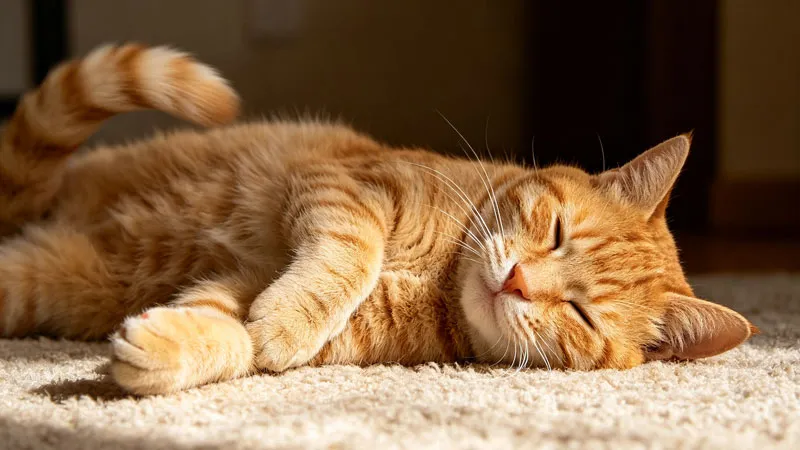
Your cat is lying down, purring loud enough to hear from across the room — and their tail won’t stop flicking. Cat tail flicking while purring while lying down looks like a contradiction, but it isn’t. Your cat is sending two signals at once: a relaxed body and an alert mind. This guide breaks down exactly what each combination means, when it points to overstimulation, and when it’s worth a call to your vet. No guesswork, just a clear framework you can use today.
Why Cats Flick Their Tail While Purring and Lying Down
The short answer: purring signals comfort, but tail flicking signals that your cat’s senses are still switched on. Cats don’t shut off their environment just because they’re relaxed. A flicking tail while lying down usually means your cat is content but tracking something — a sound, a movement, or even a thought.
Research on feline vocalizations shows purring frequencies typically fall between 25 and 150 Hz, a range some researchers link to tissue repair and self-soothing rather than pure happiness. That’s the piece most articles skip: purring isn’t a mood indicator on its own. It’s a physiological tool your cat uses in more than one emotional state.
The Science Behind It: Purring and Tail Flicking Aren’t Contradictions
What Purring While Resting Actually Signals
Purring while lying still often means your cat is in a low-stress state, but “low-stress” doesn’t always mean “blissed out.” Cats purr while healing from injury, while anxious at the vet, and while falling asleep. Context decides the meaning, not the sound itself.
Why the Tail Moves Independently of the Purr
Tail movement is controlled by a separate set of nerve pathways than the ones tied to vocal cords. That’s why a cat can be fully relaxed in the body and still have a twitchy tail — the tail is reacting to sensory input almost on its own, like a reflex rather than a mood report.
Decoding the Combination: Speed, Volume, and Position
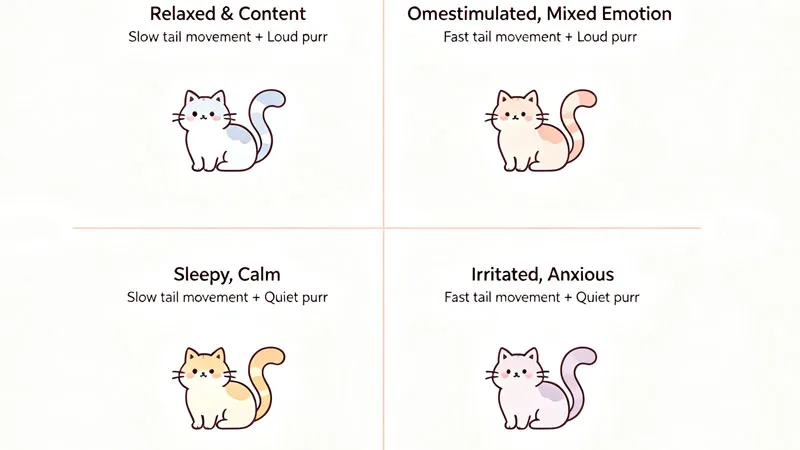
The fastest way to read your cat is to combine two variables: how fast the tail moves and how loud the purr is.
- Slow tail flick + soft purr → Content but alert. Nothing to worry about.
- Rapid tail flick + loud purr → Overstimulation building. Time to back off.
- Tail tip only, twitching → Mild irritation, often during petting.
- Tail wrapped around the body + purring → Security and self-soothing.
- Tail flicking during sleep → Likely REM activity, not a conscious signal.
- Tail thumping the floor + low purr → Frustration that’s been building for a while.
Tail Flicking vs. Wagging vs. Thumping: What’s the Difference
These three terms get used interchangeably online, and that’s part of the confusion. Here’s the actual breakdown:
| Behavior | Speed | Common Trigger | What It Signals |
|---|---|---|---|
| Flicking | Fast, small motion | Lying down, focused | Alertness or mild annoyance |
| Wagging | Medium, sweeping | Play, curiosity | Engagement or excitement |
| Thumping | Slow, heavy hits | Built-up stress | Frustration, needs space |
Knowing which one you’re seeing changes how you should respond — playing through a thump is very different from playing through a wag.
Breed and Age Differences You Shouldn’t Ignore
Not every cat reads the same way. Manx and American Bobtail cats have shortened or absent tails, so their emotional signaling shifts to ears, posture, and vocalization instead. If you own one of these breeds, tail-based cues will always be incomplete on their own.
Age matters too. Kittens flick their tails more often simply because their nervous systems are still developing sensory filtering. Senior cats, on the other hand, tend to show less tail movement overall — so a sudden increase in an older cat’s tail activity is worth watching more closely than the same behavior in a kitten.
When It’s a Medical Issue, Not Just Emotion
Most tail flicking is harmless. But persistent flicking paired with other symptoms can point to something physical.
5-Point Self-Check Before You Call the Vet
- Has your cat’s appetite changed in the last week?
- Are litter box habits different — more frequent, less frequent, or straining?
- Has your cat lost or gained weight recently?
- Is your cat grooming or biting near the base of the tail more than usual?
- Has activity level dropped noticeably?
If you answered yes to two or more, it’s worth a vet visit rather than waiting it out.
One condition almost nobody covers: Feline Hyperesthesia Syndrome, a neurological issue where cats show sudden skin rippling, tail chasing, and excessive tail licking, often triggered by stress or nerve sensitivity. It’s rare, but it’s a real reason a cat’s tail behavior can look “off” for no obvious reason. [feline hyperesthesia syndrome research]
Arthritis, flea sensitivity, and old injuries near the spine can also cause abnormal tail movement. None of these are things to diagnose at home — they’re things to rule out with a professional.
How to Respond: A Practical Action Guide
If it’s overstimulation — stop petting, step back, and let your cat come to you when ready. Don’t chase the interaction.
If it’s focus or play drive — redirect that energy with a wand toy or a [best interactive toys for indoor cats] instead of letting it build into a swat.
If it’s self-soothing — check whether your cat’s environment has changed recently. A new visitor, a moved litter box, or construction noise nearby can all trigger this. A [creating a low-stress environment for anxious cats] guide can help you spot the trigger.
Multi-Cat Households: A Different Read Entirely
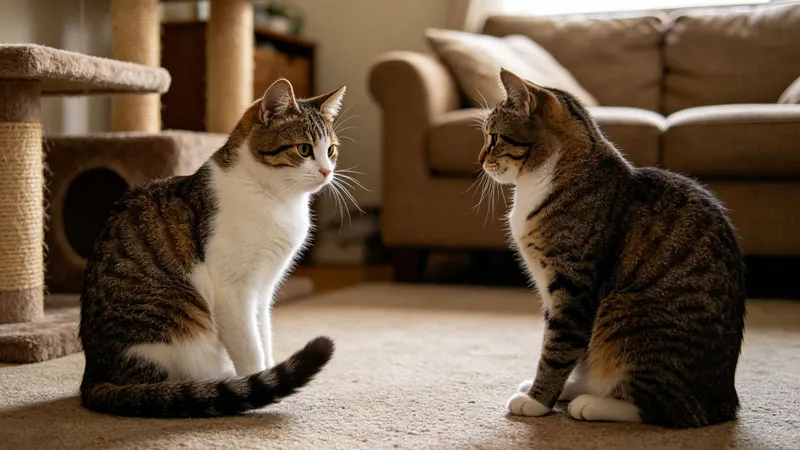
In a home with more than one cat, a purring cat with a flicking tail lying near another cat isn’t always relaxed — it can be a warning to keep distance. Watch the second cat’s reaction. If they back off or reroute their path, the flicking tail was doing its job as a boundary signal, not a mood report.
FAQ: What People Also Ask
Is it normal for a cat to purr and flick its tail at the same time?
Yes. It usually means your cat is relaxed but still processing something in the environment. It’s not a red flag on its own.
Why does my cat’s tail twitch when I pet them while lying down?
This is often the first sign of overstimulation. Watch for ear position and pupil size — if they tighten or dilate, it’s time to pause petting.
Should I worry if my cat’s tail flicks constantly while sleeping?
Not usually. Light sleepers react to sounds and smells without waking. Occasional twitching during sleep is normal reflex activity.
How do I tell playful tail flicking apart from aggressive flicking?
Playful flicking comes with forward-facing ears and a crouched, engaged posture. Aggressive or stressed flicking pairs with flattened ears, dilated pupils, and a stiff body.
Does tail flicking always mean my cat wants to be left alone?
No. Slow, controlled flicking during rest is often just alertness. Fast, sharp flicking combined with tension is the version that means “back off.”
The Bottom Line
A flicking tail during a purr isn’t a mixed signal — it’s two systems working independently. Read the speed, the volume, and what else is happening around your cat, and the picture gets clear fast. When something doesn’t add up, or the behavior shows up alongside appetite or litter box changes, a vet visit settles it faster than guessing ever will.
Disclaimer: This article is for general informational purposes only and is not a substitute for professional veterinary advice, diagnosis, or treatment. Always consult a licensed veterinarian regarding any concerns about your cat’s health or behavior.
SEO Metadata
Meta Description (156 characters):
Cat tail flicking while purring and lying down? Here’s what each combination really means, plus a vet-backed checklist for when to worry. Read now.

