Some dogs make training feel like a partnership. Others make it feel like a negotiation you’re losing.
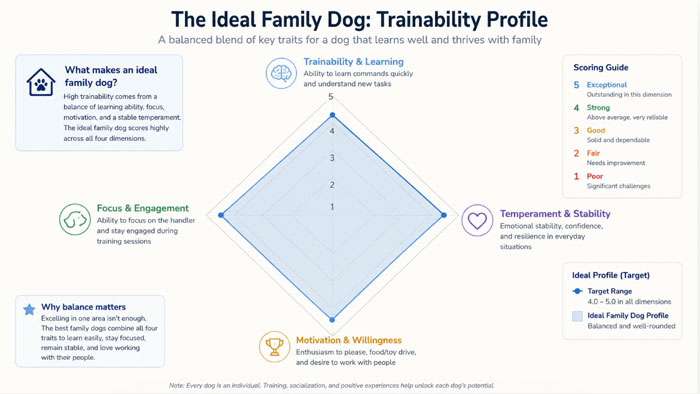
If you’re researching the easiest dogs to train, you’ve probably seen the same recycled lists — Labrador, Golden Retriever, German Shepherd, repeat. This guide goes further. We ranked 10 breeds using four real-world factors: willingness to please, food motivation, emotional stability, and energy-to-lifestyle match. No fluff. Just what you actually need before committing to a dog for the next 10–15 years.
What “Easy to Train” Actually Means (Most Lists Get This Wrong)
High intelligence does not equal easy training. This is the most common mistake first-time owners make.
Border Collies consistently top “smartest breeds” rankings. But in a typical family home — no farm, no daily agility work, no job to do — that intelligence becomes a liability. You get a dog that’s bored, anxious, and creative in all the wrong ways.
What you actually want is biddability: the dog’s willingness to work with you, not just its ability to figure things out independently.
📌 Canine behaviorist Stanley Coren, author of The Intelligence of Dogs, distinguishes between “instinctive intelligence,” “adaptive intelligence,” and “working and obedience intelligence” — the last one being what most owners actually care about day-to-day. Stanley Coren’s breed intelligence research
The four factors we used to rank every breed below:
- Biddability — Does this dog want to please you?
- Food/toy motivation — Is there a reliable reward you can use?
- Emotional stability — Can they focus when distracted?
- Energy-to-lifestyle fit — Are you actually able to meet their needs?
The 10 Easiest Dogs to Train, Ranked
Quick Comparison: Trainable Breeds at a Glance
| Breed | Size | Trainability | Energy | Kid-Friendly | Best For |
|---|---|---|---|---|---|
| Labrador Retriever | Large | ⭐⭐⭐⭐⭐ | High | ✅ | Active families |
| Golden Retriever | Large | ⭐⭐⭐⭐⭐ | Med-High | ✅ | First-time owners |
| Standard Poodle | Medium | ⭐⭐⭐⭐⭐ | Medium | ✅ | Allergy households |
| German Shepherd | Large | ⭐⭐⭐⭐ | High | ✅ | Confident handlers |
| Papillon | Small | ⭐⭐⭐⭐ | Medium | ✅ | Apartment owners |
| Australian Shepherd | Medium | ⭐⭐⭐⭐ | Very High | ✅ | Outdoor-active owners |
| Cavalier K.C. Spaniel | Small | ⭐⭐⭐⭐ | Low-Med | ✅ | Seniors, calm homes |
| Miniature Schnauzer | Small | ⭐⭐⭐⭐ | Medium | ✅ | City dwellers |
| Havanese | Small | ⭐⭐⭐⭐ | Low-Med | ✅ | Apartment, WFH owners |
| Border Terrier | Small | ⭐⭐⭐ | Med-High | ✅ | Terrier enthusiasts |
1. Labrador Retriever — The Gold Standard for a Reason
Labs weren’t bred to herd or guard. They were bred to work alongside humans — retrieving game, reading their handler’s cues, and doing it again all day. That history shows up in training.
Why they’re easy: Extremely high food drive, stable temperament, almost no sensitivity to handler mistakes. If you accidentally train something wrong, Labs are forgiving enough to retrain.
What most articles skip: Labs under two years old are powerful and impulsive. “Easy to train” doesn’t mean “automatically well-behaved.” They need consistent structure from day one — especially on-leash manners.
Best approach: Start leash training and impulse control (sit before meals, wait at doors) in week one. Their food drive makes reward-based training highly effective.
Health note: Labs are genetically predisposed to obesity. Use training treats as part of their daily food allowance, not on top of it.
2. Golden Retriever — Eager to Please, Easy to Love
Goldens are the breed most professional trainers recommend for first-time owners. The reason is temperament, not just intelligence. They’re emotionally stable, socially confident, and genuinely enjoy the training process.
Why they’re easy: High biddability, strong food and praise motivation, and they recover quickly from correction without shutting down.
What most articles skip: Goldens mature slowly. Expect puppy behavior — jumping, mouthing, excitability — well into year two. Patience is non-negotiable.
Best approach: Short, frequent sessions (5–10 minutes) work better than long ones. They thrive on variety; repeat the same drill too many times and they disengage.
Health note: Golden Retrievers have above-average cancer rates. Annual vet screenings are strongly recommended after age six. Golden Retriever cancer risk statistics
3. Standard Poodle — The Most Underestimated Breed on This List
Most people picture a groomed show dog. What Poodles actually are: working water retrievers with some of the highest obedience intelligence of any breed. The haircut is a red herring.
Why they’re easy: Exceptional problem-solving ability, high motivation, and a strong desire to interact with their people. They pick up new commands fast — sometimes in just a few repetitions.
What most articles skip: Poodles are emotionally sensitive. Harsh corrections backfire. They need positive, consistent handling — not military-style commands.
Best approach: Use marker training (a clicker or verbal “yes”) to capture desired behaviors. Their brain needs stimulation as much as their body; puzzle feeders between sessions help.
Ideal for: Allergy-sensitive households — their low-shedding coat is a genuine advantage.
4. German Shepherd — Power and Precision (Needs a Confident Handler)
German Shepherds are highly trainable, but they’re not beginner-proof. They’re used as police dogs and service animals because they’re capable of anything — which means an under-trained GSD is a significant management challenge.
Why they’re easy (with the right owner): Extremely loyal, focused, and motivated by both food and praise. They form deep bonds with their handler, which accelerates training.
What most articles skip: Their guarding instinct needs active management. Without proper socialization before 16 weeks, reactivity toward strangers or other dogs is common.
Best approach: Obedience training should start at 8 weeks. Socialization isn’t optional — it’s structural.
early puppy socialization checklist
5. Papillon — Small Dog, Competition-Level Brain
Don’t let the size fool you. Papillons consistently place in the top 10 of obedience and agility competitions — beating breeds three times their size.
Why they’re easy: High biddability, strong food and play motivation, and an outgoing temperament that doesn’t spook easily.
What most articles skip: They need more mental stimulation than most small dogs. A bored Papillon barks. A lot.
Best approach: Trick training keeps them sharp and satisfied. Agility work — even informal backyard versions — is ideal.
6. Australian Shepherd — Best in Class, Not for Everyone
Aussies are remarkable dogs. They’re also the breed most likely to end up in rescue because the owner didn’t do their research.
Why they’re trainable: Incredibly smart, highly motivated, and love having a job. Owners who engage consistently get astonishing results.
What most articles skip: “High energy” is an understatement. Aussies need 1.5–2 hours of real activity daily — not a backyard to run in alone. Under-exercised Aussies develop compulsive behaviors: spinning, chasing shadows, excessive herding of children.
Best for: Runners, hikers, active families who will commit to ongoing training.
7. Cavalier King Charles Spaniel — The Gentle Achiever
Cavaliers are one of the few breeds that combine genuine trainability with a genuinely low-key temperament. They’re calm enough for apartment life but engaged enough to learn reliably.
Why they’re easy: People-oriented, gentle, and responsive to quiet positive reinforcement. They don’t require a high-intensity handler.
Health note: Cavaliers have a high prevalence of mitral valve disease (MVD). Responsible breeders should provide cardiac clearances. Verify before purchasing.
8. Miniature Schnauzer — Alert, Loyal, City-Ready
Miniature Schnauzers are terrier-adjacent but without the full terrier stubbornness. They’re watchful, responsive, and adapt well to urban environments.
Why they’re easy: Medium energy, strong food motivation, and a natural desire to be involved with their family’s activities.
What most articles skip: Their alerting instinct means they bark — at everything. Bark-on-command and quiet-on-command training should be a week-one priority.
9. Havanese — The Apartment Owner’s Best Option
Havanese are compact, affectionate, and easier to manage than their silky-coated appearance suggests. They’re sometimes called “velcro dogs” — they follow their people everywhere and genuinely want to participate.
Why they’re easy: Low exercise threshold, high people-orientation, and quick to pick up household routines.
Best approach: They’re sensitive to tone of voice. Keep sessions upbeat, never frustrated.
best dog breeds for apartment living
10. Border Terrier — The Scrappy Overperformer of the Terrier World
If you love terriers, this is the one to pick. Border Terriers were bred to work alongside hound packs — which means more handler-focus than most terrier breeds.
Why they’re trainable (for a terrier): Determined, loyal, and more cooperative than their independent-minded cousins.
What most articles skip: Prey drive is real and strong. Off-leash recall around small animals is not guaranteed without extensive training.
Dogs That Look Easy But Aren’t — Avoid These Traps
Why Border Collies Fail in Most Family Homes
Border Collies are genius-level dogs. They’re also deeply mismatched with average family life. Without a genuine job — and “a walk around the block” doesn’t count — they develop anxiety, compulsive behaviors, and reactivity. Rescue organizations consistently report Border Collies as one of the most commonly surrendered working breeds in North America.
The “Cute Tax” Problem
French Bulldogs, Huskies, and Dachshunds are perennial adoption favorites — largely for aesthetic reasons. None of them are easy training matches for most first-time owners. Huskies have low biddability and extremely high independence. Frenchies have respiratory limitations that affect exercise capacity. Dachshunds are stubborn and prone to back problems that complicate physical training.
Choose your dog for fit, not for the Instagram grid.
How to Set Any Dog Up for Training Success
The First Two Weeks: Build Routine Before You Build Commands
Most owners start with “sit” and “stay.” The more effective approach: establish routine first. Same feeding times, same sleep spot, same potty schedule. Predictability reduces anxiety — and a calm dog learns faster.
Positive Reinforcement Is Not Negotiable
The American Veterinary Society of Animal Behavior (AVSAB) formally recommends reward-based training as the primary method for all dog training. Punishment-based methods increase fear, anxiety, and aggression — regardless of breed.
Use food, praise, or play as rewards. Mark the exact moment the behavior happens. Repeat.
When to Call a Professional
If your dog shows resource guarding, fear-based reactivity, or aggression before six months — stop DIY training and find a certified professional. Look for a CPDT-KA certified trainer. Avoid anyone who still promotes dominance theory or alpha rolls; the science doesn’t support it.
FAQ: Your Questions About Easy-to-Train Dog Breeds, Answered
What is the single easiest dog to train for a first-time owner?
A: Labrador Retrievers and Golden Retrievers consistently top this list for beginners — not because they’re the smartest, but because they’re forgiving of handler mistakes and highly food-motivated.
Q: What’s the easiest dog to train that doesn’t shed much?
A: Standard or Miniature Poodle. Exceptional trainability plus a low-shedding coat. Grooming costs are higher, but the allergy benefit is real.
Q: Are small dogs harder to train than large dogs?
A: No — but they’re more likely to be under-trained. Owners tend to tolerate bad behavior in small dogs that they wouldn’t accept in a Lab. The dog isn’t harder to train; the owner is less consistent.
Q: What’s the easiest dog to potty train?
A: Breeds with high routine-sensitivity — Labs, Goldens, and Havanese — typically potty train fastest because they adapt quickly to schedule-based systems. Toy breeds take longer due to smaller bladder capacity, not stubbornness.

