How long does a cat stay in heat? Most female cats stay in heat for 4 to 10 days, and the cycle can repeat every two to three weeks until she’s spayed or becomes pregnant. If your cat is suddenly yowling at 2 a.m. and rubbing on every surface in the house, this guide breaks down exactly what’s happening, what’s normal, and what needs a vet.
What Does It Mean When a Cat Is “In Heat”?
Heat, or estrus, is the fertile window in a cat’s reproductive cycle. Her body is telling every unneutered male in the neighborhood that she’s ready to mate.
Cats are induced ovulators. Unlike humans, they don’t release eggs on a fixed schedule. Ovulation only happens after mating. That’s why an unbred cat keeps cycling back into heat every few weeks during breeding season — her body never gets the signal to stop.
When Do Cats First Go Into Heat? Age and Breed Differences
Most cats hit their first heat between 5 and 9 months old. But breed matters more than most owners realize.
| Breed Type | Average Age at First Heat | Cycle Frequency |
|---|---|---|
| Domestic shorthair/mixed | 5–9 months | Every 2–3 weeks (in season) |
| Siamese, Oriental breeds | 4–5 months | Often more frequent |
| Maine Coon, larger breeds | 9–12 months | Slightly less frequent |
learn about spaying age recommendations by breed
How Long Does a Cat Stay in Heat, Exactly?
Here’s the direct answer: active estrus lasts 4 to 10 days on average. Add the 1–2 day warm-up phase before it, and you’re looking at roughly a week to ten days of noticeable behavior from start to finish.
Individual cats vary. Some show mild signs for two days. Others stay vocal and restless for up to two weeks. Genetics, stress, and lighting conditions all play a role.
Cornell Feline Health Center’s overview of feline reproduction
The Complete Feline Estrous Cycle, Stage by Stage
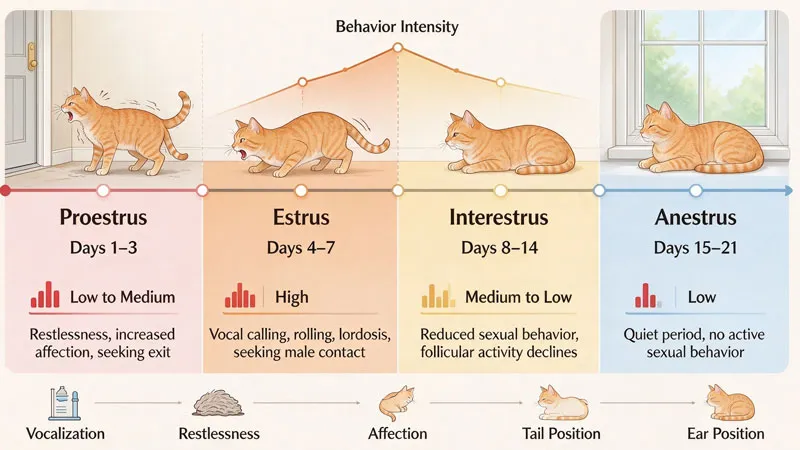
Proestrus (1–2 Days): The Warm-Up Phase
Hormones start rising. Your cat may get a little clingy or restless, but she’s not yet receptive to mating. Easy to miss if you’re not watching closely.
Estrus (4–10 Days): Peak Fertility
This is what people mean by “in heat.” Loud calling, rolling on the floor, raised hindquarters, treading with her back feet — this is her body broadcasting fertility.
Interestrus (1–3 Weeks): The Pause Button
If she doesn’t mate, she enters interestrus. Behavior settles down before the next cycle kicks off. This gap shortens during peak breeding months.
Anestrus: The Seasonal Off-Switch
A dormant stretch, usually triggered by shorter daylight hours in late fall and winter. Here’s the catch most guides skip: indoor cats under artificial lighting can skip anestrus entirely and cycle year-round, even in December.
How Often Do Cats Go Into Heat?
Cats are seasonally polyestrous — they cycle repeatedly during breeding season, not just once a year. In most of North America, that season runs February through October, driven by increasing daylight.
An unspayed cat that doesn’t mate will come back into heat every 2–3 weeks throughout that stretch. Indoor cats near bright lamps or south-facing windows sometimes never fully stop, regardless of the calendar.
Signs Your Cat Is in Heat
Check for these together, not in isolation — one or two alone could mean something else entirely:
- Loud, persistent yowling, especially at night
- Rubbing against furniture, doorways, and your legs
- Raised hindquarters with tail held to the side
- Rolling and low-crawling on the floor
- Restlessness or pacing
- Excessive grooming around the hindquarters
- Attempts to slip outside
- Slight appetite dip during peak calling days
Physical Symptoms Owners Always Ask About
Does a Cat in Heat Bleed?
No. Unlike dogs, cats don’t bleed during estrus. If you spot blood or discharge, that’s not heat — that’s a reason to call your vet the same day.
Is Being in Heat Painful?
Not painful in the medical sense, but uncomfortable. The restlessness and vocalizing reflect hormonal drive, not pain. A cat that seems genuinely distressed, hunched, or won’t eat needs a vet visit, not reassurance.
Silent Heat: When Your Cat Shows No Signs at All
Some cats cycle with almost no visible symptoms. No yowling, no floor-rolling, just subtle shifts in affection or appetite. Owners often miss it entirely and are surprised weeks later by an unplanned pregnancy. If your unspayed cat has ever spent unsupervised time outdoors, don’t assume “no signs” means “no risk.”
When Repeated Heat Cycles Signal a Problem
A cat cycling nonstop for weeks without a break, or showing heat behavior that won’t quit even outside breeding season, isn’t just “intense.” That pattern can point to ovarian remnant syndrome (tissue left behind after an incomplete spay) or ovarian cysts. This isn’t something to wait out — it needs diagnostic bloodwork and an exam.
Signs your spayed cat may still be cycling
Caring for a Cat in Heat at Home
- Keep her strictly indoors — screened windows, secure doors, no cat flap access
- Give her a quiet space away from household traffic
- Offer extra play sessions to burn restless energy
- Try a pheromone diffuser if she’s especially wound up
- Don’t punish the yowling — it’s hormonal, not behavioral
Managing a Multi-Cat Household
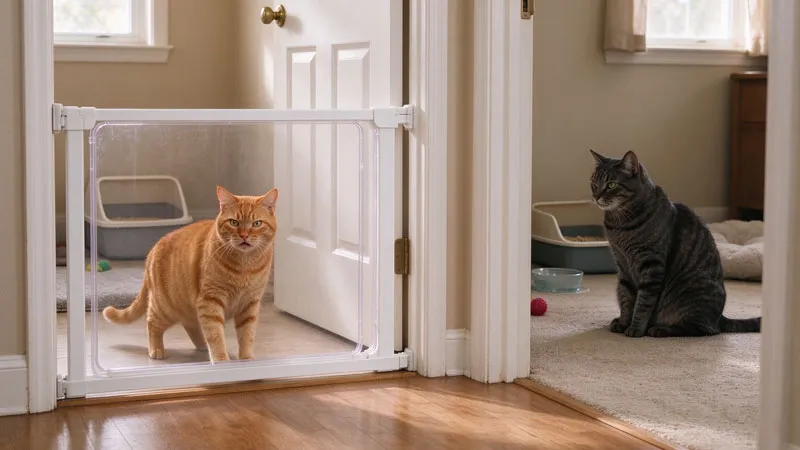
This is where things get messy fast. An unneutered male in the same house will spray, pace, and try to reach her constantly. Separate them completely — different rooms, different litter boxes — and clean sprayed areas with an enzymatic cleaner, not regular soap, or the scent marker lingers and triggers repeat spraying.
Spaying: The Only Long-Term Fix
Nothing you do at home stops the cycle. Spaying is the only permanent solution.
Health Benefits, Backed by Numbers
Spaying before the first heat cycle cuts mammary tumor risk dramatically compared to waiting until after two or more cycles. It also eliminates pyometra risk entirely — a uterine infection that can turn life-threatening within days.
American Veterinary Medical Association’s spay/neuter position statement
How Much Does It Cost to Spay a Cat?
Budget matters, and most guides skip this. Standard veterinary clinics typically charge $200–$500, depending on your region and the cat’s age. Low-cost and nonprofit clinics often bring that down to $50–$150. Check local humane societies or ASPCA-affiliated programs before assuming you can’t afford it — subsidized spay programs exist in most metro areas.
Can You Spay a Cat While She’s in Heat?
Yes, but expect a slightly longer, slightly bloodier surgery because the reproductive tissue is engorged. Most vets will still do it if needed; some prefer to wait a couple of weeks for interestrus. Ask your vet what they recommend for your specific cat.
Early vs. Delayed Spay: What Current Research Actually Says
The “spay before first heat, always” rule isn’t universal anymore. Recent veterinary guidance suggests some larger breeds may benefit from waiting until closer to 12 months for joint and growth-plate development. This is a genuine, ongoing debate in veterinary medicine — not a settled fact. Talk to your vet about your cat’s breed and size before locking in a date.
When is the best age to spay your cat
Common Myths, Debunked
Myth: She should have one litter first. No health benefit exists for this. It only adds risk.
Myth: Mating calms a cat down. It doesn’t — it just restarts the cycle after pregnancy or ends it temporarily.
Myth: Indoor cats don’t need to worry about heat. Wrong. Indoor cats cycle just as often, sometimes more, thanks to artificial light.
When to Call Your Vet
Contact your vet right away if you notice:
- Blood or foul-smelling discharge
- Lethargy or refusal to eat
- Heat signs lasting more than two weeks straight
- Behavior that seems more like distress than hormones
- Any chance she mated and you’re unsure what to do next
Frequently Asked Questions
Can a cat get pregnant during her very first heat?
Yes. Even a young cat in her first cycle can conceive. Keep her indoors and talk to your vet about spaying timing as soon as possible.
How do I know if my cat is in heat or just sick?
Heat behavior comes with vocalizing, affection, and posturing but no fever, vomiting, or loss of appetite. If she’s lethargic or won’t eat, that’s illness, not heat — call your vet.
Do male cats go into heat too?
No. Males don’t have an estrous cycle, but they respond strongly to a female in heat with spraying, roaming, and increased vocalization of their own.
Is it normal for heat to last two full weeks?
It happens, but it’s on the longer end. If it consistently runs past 10–14 days or never fully stops, mention it to your vet — it could point to a hormonal or ovarian issue.
What’s the difference between a cat in heat and a cat in pain?
Heat behavior is loud but the cat still eats, moves normally, and seeks attention. Pain usually shows as hiding, hunching, reduced appetite, or aggression when touched.
Disclaimer: This article is for general informational purposes only and does not replace professional veterinary advice, diagnosis, or treatment. Always consult a licensed veterinarian regarding your cat’s specific health, reproductive care, or spaying decisions.

