Your cat isn’t just “acting weird.” Lonely cat syndrome is real, and it shows up in ways most owners miss until the behavior gets destructive. This guide breaks down the actual signs, how long is too long to leave a cat alone, and what works — backed by feline behavior science, not guesswork.
What Is Lonely Cat Syndrome? (And Is It a Real Diagnosis?)
Here’s the honest answer: lonely cat syndrome isn’t a formal veterinary diagnosis. You won’t find it in a vet’s clinical notes. It’s a descriptive term for a real, observable pattern — a cat showing stress, boredom, or attachment-related behaviors linked to insufficient social interaction.
That distinction matters. It means the label doesn’t replace a vet visit. It describes a pattern you can act on.
Lonely Cat Syndrome vs. Single Cat Syndrome vs. Single Kitten Syndrome
These three terms get used interchangeably online. They’re not the same thing.
| Term | Typical Age | Main Cause | Needs Professional Help? |
|---|---|---|---|
| Lonely cat syndrome | Any age | Insufficient interaction, understimulation | Sometimes — if behaviors are severe |
| Single cat syndrome | Adult cats | Living without feline companionship | Rarely — usually manageable at home |
| Single kitten syndrome | Kittens under 12 weeks | Missed littermate socialization (bite inhibition, play limits) | Often — early intervention prevents lifelong issues |
Cats are what behaviorists call facultatively social — they can live solo, but they evolved with flexible social structures, not solitary ones. That’s the root of why isolation affects them more than the “independent cat” stereotype suggests.
The domestic cat’s ancestor, the African wildcat (Felis silvestris lybica), is essentially a solitary ambush predator that hunts small, dispersed prey and has no need for cooperative hunting. Felids as a family therefore lack the obligate group living seen in canids.
Around human settlements, however, domestic cats evolved what is often described as facultative sociality. When food is concentrated and reliable (grain stores, refuse sites, feeding stations), individuals tolerate close proximity to one another and may form colonies built around related females, who share territory and raise kittens communally. When food is scattered, they revert to solitary living and individual home ranges.
Cat social structure is thus not a fixed species trait but shifts flexibly with resource distribution. This background also explains why, in multi-cat indoor households, the number and placement of resources (food bowls, water, litter boxes, resting spots) directly affect tension between cats.
Suggested sources (please verify before citing):
- Crowell-Davis et al. (2004), Journal of Feline Medicine and Surgery, a review of social organization in domestic cats. This is the closest match to the claim.
- Driscoll et al. (2007), Science, on the Near Eastern origin of cat domestication, which supports the wildcat-to-domestic-cat background.
- Ohio State University Indoor Pet Initiative, for the practical point about resource allocation in indoor environments.
How Long Is Too Long? Safe Alone-Time Thresholds by Age
This is the question nobody answers with actual numbers. Here’s a working framework based on age and temperament.
| Life Stage | Comfortable Alone Time | Risk Zone |
|---|---|---|
| Kittens (under 6 months) | 2–4 hours | 8+ hours without a check-in |
| Adult cats | 8–10 hours | 24+ hours regularly |
| Senior cats (10+) | 4–6 hours | 8+ hours, especially with mobility or cognitive decline |
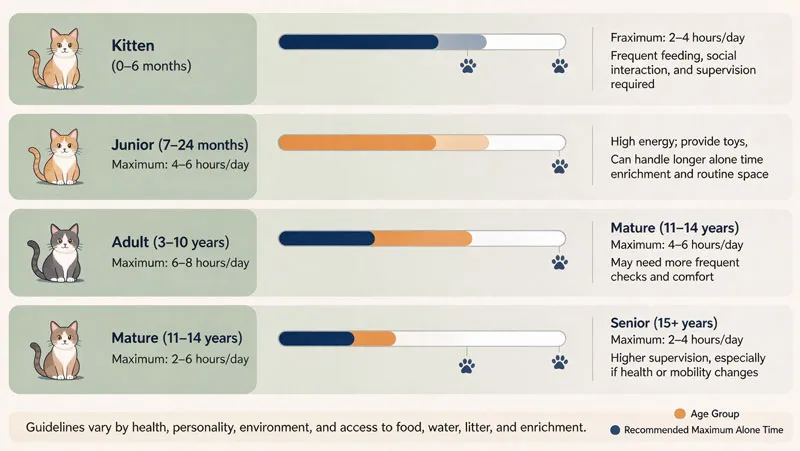
These are starting points, not rules. A high-energy Siamese hits the risk zone faster than a laid-back Ragdoll. Watch behavior, not just the clock.
12 Signs Your Cat May Be Lonely (Ranked by Severity)
Not every sign carries the same weight. Here’s how to triage what you’re seeing.
Mild Signs — Early Warning
- Increased vocalization when you’re home
- Following you room to room
- Waiting by the door before you leave or arrive
- Clinginess during normal activities
Moderate Signs — Needs Attention
- Overgrooming, especially on the belly or legs
- Litter box avoidance without a medical cause
- Appetite changes tied to your schedule
- Disrupted sleep patterns, especially night waking
Severe Signs — Consult a Vet or Behaviorist
- Overgrooming to the point of bald patches or skin irritation
- Redirected aggression toward you or other pets
- Destructive behavior that causes property damage or self-injury
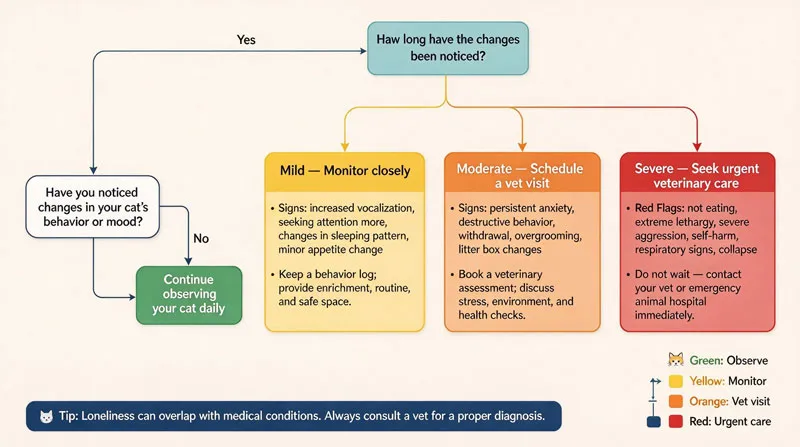
Every one of these signs overlaps with medical conditions — thyroid disease, urinary issues, arthritis, allergies. Rule out health problems first. Behavioral fixes won’t touch a medical root cause.
Lonely Cat Syndrome vs. Separation Anxiety vs. Medical Issues
These three get confused constantly, and the fix for one won’t fix the others.
| Factor | Lonely Cat Syndrome | Separation Anxiety | Medical Issue |
|---|---|---|---|
| When it shows up | Ongoing, low-grade | Specifically when you leave/arrive | Any time, often worsening |
| Typical behaviors | Attention-seeking, mild destruction | Panic-like distress, vocalizing at departure | Symptom-specific (urination, vomiting, limping) |
| Best first step | Increase enrichment and routine | Behaviorist consult | Vet visit |
Guidance on feline separation-related behaviors
If your cat only panics at departure cues — grabbing keys, putting on shoes — that’s anxiety, not loneliness. Different problem, different playbook.
Which Cats Are Most at Risk?
Higher Risk
- Affectionate breeds: Siamese, Burmese, Ragdoll
- Former strays or ferals used to group living
- Senior cats who lost a longtime companion
- High-energy cats without enough physical outlets
Lower Risk
- American Shorthair, Russian Blue, Norwegian Forest cat
- Cats with consistent routines and regular human contact
- Naturally low-activity individuals
Breed trends are a starting point, not a diagnosis. Individual temperament overrides breed generalizations more often than owners expect.
What to Do If Your Cat Is Lonely (Without Adopting Another Cat)
Build a Predictable Daily Routine
Cats regulate stress through predictability. Same feeding times, same play windows, same wind-down routine before you leave. Consistency does more than any single toy.
Environmental Enrichment That Actually Works
Skip the single squeaky mouse. Rotate toys weekly. Puzzle feeders slow down eating and add mental work. Motion-activated toys cover the hours you’re not home.
Interactive puzzle feeders and enrichment toys for indoor cats
Window Perches, Catios & Bringing the Outdoors In
A sunny window perch with a bird feeder outside does more for a bored cat than most toys combined. Catios add safe outdoor stimulation without the risks of free roaming — outdoor cats face significantly shorter lifespans than indoor-only cats.
Pheromone Products — What the Evidence Actually Shows
Feliway and similar products get recommended constantly. Here’s the nuance: evidence for pheromone efficacy is mixed, with some studies showing modest stress reduction and others showing no significant effect beyond placebo. Treat it as one tool, not a fix.
Hiring a Pet Sitter or Companion Service
If you work long hours, a midday visit from a sitter breaks up isolation without requiring a second pet. This matters most for renters or owners with space or budget limits that rule out another cat.
Should You Adopt a Second Cat? A Balanced Framework
Signs Your Cat Would Benefit From a Companion
- Seeks out interaction constantly, even when you’re present
- Shows boredom-driven destruction despite enrichment
- Is young, playful, and under-stimulated by solo play
Signs Your Cat Might Prefer to Stay Solo
- Hides or acts stressed around other animals
- Is older and set in a solo routine
- Has a history of resource-guarding or territorial behavior
The Risk Nobody Talks About: When Pairings Don’t Work
Adding a second cat isn’t a guaranteed fix. Mismatched pairs can mean ongoing resource competition, fighting, or one cat retreating permanently. A slow, structured introduction — separate spaces first, scent swapping, gradual visual contact over weeks — matters more than which cat you pick.
Official position on multi-cat household introductions
When to Contact a Vet or Certified Cat Behaviorist
Call in help if you see: self-injury from overgrooming, aggression that draws blood, or behavior that escalates despite consistent enrichment. A Certified Cat Behavior Consultant (CCBC) handles behavior specifically — different training than a general trainer.
How to find a certified feline behavior consultant near you
FAQ
Can a cat die from loneliness?
Not directly, but chronic stress from isolation weakens immune function and can worsen existing health conditions over time.
Is it cruel to have only one cat?
No. Many single cats thrive with enough routine, enrichment, and human interaction. Loneliness risk depends on the individual cat, not the household size.
Do male or female cats get lonelier?
Sex isn’t the main factor — temperament, early socialization, and breed tendencies matter far more than sex.
Can a dog help with lonely cat syndrome?
Sometimes, but it’s not a substitute for feline social contact. Cat-to-cat play meets needs a dog physically can’t replicate.
How fast can lonely cat syndrome improve?
Mild cases often improve within 2–3 weeks of consistent routine and enrichment. Severe cases need longer, sometimes with behaviorist support.
Key Takeaways
- Lonely cat syndrome isn’t a formal diagnosis — it’s a real, observable behavior pattern
- Watch severity, not just presence, of signs — mild signs rarely need intervention beyond routine changes
- Rule out medical causes before assuming behavioral roots
- A second cat can help, but mismatched pairings create new problems
- Escalating or self-injurious behavior warrants professional help, not just more toys
Disclaimer: This article is for general informational purposes only and does not substitute for professional veterinary or animal behavior advice. If your cat shows signs of distress, injury, or a sudden behavior change, consult a licensed veterinarian or certified animal behaviorist.

